
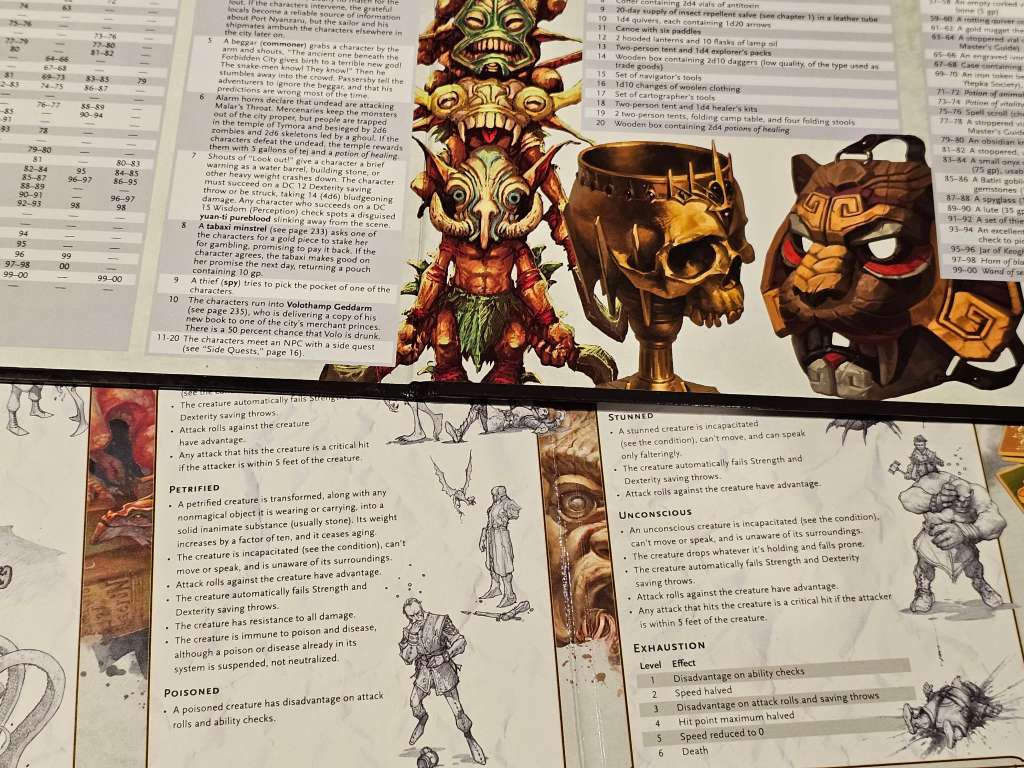
The Dungeon Master screen: an iconic piece of all table top role playing games. The protector of your dungeon masters campaign secrets, dice rolls, and virginity. There’s a certain allure to having a DM screen. To some it’s a cherished aesthetic born of old tradition. To others, it gives organization.
For many years, I have appreciated the DM screen. It’s iconic and mysterious to those looking in from the outside. While being unassuming, it has a vast number of practical functions.
It’s a space which can have quick references printed inside, or even sticky noted along the top. It gives you some personal space, literally dividing you from the players; a symbolic division of roles within the game. It allows for the creation of suspense with your players unable to see your dice rolls and by extension allows you to railroad a story without the players feeling like they’re being railroaded. And most importantly, it’s a safety net that your game doesn’t end because your dice chose to roll 3 natural 20’s in a row.
You know what else the DM screen is?
A liar and a thief.
It is the crutch used by fledgling DM’s who I believe could run a better game without it if they just took the risk.
When you are learning how to dungeon master, you need those guard railings. It’s scary to fumble when you’re first learning a new skill. But eventually, the training wheels come off the bike. You might fall off every once and a while, but that’s ok. It just means we learned something new that day.
So let’s talk about why I stopped using a DM screen and why I think you should too.
To start off, as described earlier the DM screen is a special space for our special dungeon master to have all their special notes and special rules references organized away from our apparently less special players so that they have a very special place which keeps their game safe from the very not special players going off the very special rails of their extremely special game.
Let’s translate that terrible paragraph.
At some point, you don’t need to organize piles of reference sheets and notes. For a 3-4 hour session, you might need a sheet or two for combats. Then some NPC notes just incase they ask why Gabe the Gnome talks funny (I don’t know why he talks like that, Daniel. He’s British I guess) again, maybe a page at most. Then your quest and dungeon notes. I’d say for a four hour session, unless your players are super efficient at clearing combats and dungeons (they’re not) you maybe need 3 pages for that. That’s like, 6-8 sheets, if the notes are detailed, and that’s implying you’re not using a device to run your games like a tablet or laptop. Or using some external program to run your combats.
For real, we’re in a post Covid age, many games are online now, and I promise you those DM’s don’t need a space for notes outside of: [ANY DOCUMENT TYPING PROGRAM GOES HERE]
So unless you’re really dedicated to having your entire worlds notes on loose pieces of paper (Get a binder, seriously, there’s no way you need to have enough space for an entire binder behind your DM screen for a 10 second note check on why Gnomes hate 6 leaf clovers.) It’s time to ditch the DM screen.
“What about hiding my dice rolls? I can create suspense and control the game so much more!”
You know what creates suspense? Good story telling.
You know what’s not suspenseful? Your super min-max high armor class player never believing that you actually hit them because they can’t see your dice, and only 19s and 20s are going to hit them.
Want real suspense? Roll two natural 20’s in a row, in front of everyone and watch that players face drop as they panic when the githyanki warrior hits them with 4d6 slashing and 4d6 psychic damage. Twice. This is story telling that would not be believed by your players without seeing it.
What’re they going to do? Accuse you of punishing their min-max nature? The chaos of dice never lie. Death just became real for this player. No longer in their mind a character they get to play until you decide to fudge 13 dice in a row.
If your game needs such an amount of control to be good, you should probably go back to the drawing board, find a new way to deliver the story you want to tell, and come back with something able to stretch and adapt.
Connecting with my final point, the DM screen divides you from the players. It is as I said, a literal and symbolic divide in roles.
I don’t like that.
While it’s important to know you have a different way of interacting with the game and tools to do so, dividing yourself from the group creates the us versus them mentality. When you don’t hide behind the DM screen, you become a part of the party. You share their same lows when the githyanki warrior does roll two natural 20’s, but then the same highs when the big bad guy Craig, misses all his devastating attacks. Their triumphs are your victories.
Can you truly celebrate the parties victory if you choose to say that on a killing blow the villain missed? Your honesty makes them feel better too. When that villain does miss the killing blow, and all your players see it happen, they feel lucky, not spared.
I promise you, that you will see a difference in celebration between a hard battle with a DM screen and celebrations without. You show that the dice, while cruel, can be beaten with good strategy.
Want to see your players band together? Show them that the odds can be beaten.
The short of this is, if you give up some control you will be rewarded with a more engaging experience. I’m not saying tell your players what a monsters stat block is, or what the DC of a skill check was. What I am saying is that just because you’re told you can make up dice rolls and hide all your secrets doesn’t mean you should.
Want to become a better DM? Become flexible. Use the shock of your dice rolls to weave a truly exciting narrative that would come off as forced and cheap behind a screen.
Want the biggest secret to DMing?
My brother in Bhaal, it’s just a game. If something truly cataclysmic happens, such as your players rolling a crazy amount of natural 1’s (Daniel), and the enemy wizard rolling max damage on a 6th level fire ball (Not Daniel), and Brendan just rolled a 1 on his death save killing him; you can just say these magic words:
“Hey, this is no fun. Want to just say that didn’t happen and redo the last round?”
You’ll likely get a “Gods, yes please, that was a miserable round.”
Or maybe you’ll all find joy in the beauty that is a complete breakdown of the game. That’s ok too.
That’s really all I have to say. I’m not saying you have to stop using a DM screen. This article is largely over-exaugurated for the sake of emphasis. I understand why people use them, they’re awesome and iconic for a reason. I just hope you consider a different approach to DMing. It’s one of the best parts of TTRPGs, we can all do something different and have a great time. Try it for one or two sessions, maybe you’ll be preaching the good word of No-Screen Josh before you know it. Or tell everyone I have no idea what I’m talking about. That’s fine too.
Be safe. Drink water. Buff monks.

 3UpTableTop
Leave a comment